Websites Built
Businesses Served
Years in Business
Google Rating
Three things quietly decide whether an ecommerce store here makes money or just makes noise.
Cash on delivery is still how a large share of North India buys. Every refused parcel costs you the shipping out, the shipping back and the packaging, and the sale was never real. A store that ignores returns to origin can run busy all month and still lose money.
A dealer wants fifty pieces, a rate slab, a GST invoice and thirty days to pay. A retail customer wants one piece delivered on Thursday. Most templates assume you only have the second kind, so Delhi traders end up running two systems and reconciling them by hand.
Marketplaces take a commission on every order and keep the buyer's details. You cannot email them, you cannot retarget them, and the moment you stop discounting they belong to somebody else. Your own store is the only channel where a repeat customer is actually yours.
The first question we ask is not what the store should look like. It is how you price. One rate for everybody, or a dealer slab and a retail slab? That single answer changes the catalogue, the checkout and the invoice, and it is far cheaper to settle before anybody opens a design file.
The second question is how you get paid. If cash on delivery is a large share of your orders, the checkout needs verification steps that a standard theme simply does not ship with. We build those in from the start rather than bolting them on after the first bad month.
We have handled ecommerce website designing and development for more than 600 businesses since 2019, and our Delhi office is in Dwarka Sector 12. Businesses across the border in Gurugram are served from our ecommerce development company in Gurgaon page, and search work sits with our SEO team.
Checkout Built for COD
OTP verification and pin code checks before dispatch.
Dealer and Retail Rates
One catalogue, two price lists, no duplicate site.
Scroll down. Each service card sticks as the next one slides over it.
For catalogues that break a template. Thousands of SKUs, sizes and colours that each carry their own stock, or a pricing rule nobody else supports. We write the product model around how your inventory actually behaves instead of forcing it into someone else's plugin.
The fastest route off a marketplace. We lift the catalogue and photographs you have already built up on Amazon or Meesho and put them on a Shopify store you control. Payments and shipping get wired up so both channels can run while the commission share falls.
No monthly licence and nothing locked behind a platform. WooCommerce suits a business that wants to own the whole stack, or one whose pricing rules are too unusual for a hosted plan. It needs a hosting plan that can take the traffic, which is where most cheap builds fall over.
This is the one Delhi asks for most. Your dealers log in and see their own rate slab, their minimum order quantity and their outstanding balance. Retail visitors see the public price on the same catalogue. The orders that used to arrive as WhatsApp photographs now arrive as line items.
A Gandhi Nagar garment wholesaler and a Nehru Place electronics dealer need very different checkouts.
Garments & Apparel
Electronics & IT
Jewellery
Auto Parts
Home & Furnishing
Handicraft Exports
Five steps. Pricing and payments are settled before a single page is designed.
Catalogue & Pricing
Your product list comes first, and whether it carries one price or a dealer slab too.
Payments & Shipping
Then the gateway, whether COD is offered, and which couriers cover your pin codes.
Design & Build
The product page and checkout are designed first. You approve both before the rest.
Testing & Migration
Orders, refunds and invoices get tested, then products and customers move across.
Launch & Listing
Launch ships with product schema, a sitemap and your Business Profile updated.
Built to Cut Returns
OTP verification on the number, a pin code check against your courier coverage, and a confirmation message before dispatch. Cutting refused parcels does more for your margin than any discount campaign.
Wholesale and Retail Together
Dealers see their slab, retail visitors see the public rate, and both run off one product list. No second website, and no reconciling two catalogues every time a price moves.
Product Pages That Rank
Product schema, unique titles and descriptions, clean category URLs and a sitemap submitted at launch. Most stores we inherit have none of it, which is why their products never surface.
Set Up for How India Pays
UPI, cards, net banking, wallets and cash on delivery, with GST invoices generated per order. We configure what your business actually needs rather than switching on every option.
The Customer List Is Yours
Every order on your own store gives you a name, a number and a buying history. That list is the asset a marketplace will never hand over, and it is what makes the second sale cheap.
You Own Every Account
Domain, hosting, payment gateway and customer data are registered to your business. Handover includes the logins and a recorded walkthrough, so adding a product never waits on us.
Filter by job. We pick the tool that costs you least over three years, not the one we like most.
Six decisions, mostly commercial rather than technical.
Spending on ads while a chunk of your parcels come back just buys more returns. Verify the number, check the pin code, confirm before dispatch, and consider a token advance on cash on delivery. Get that right and the same ad budget starts producing a completely different result.
Minimum quantity, rate slabs, how long credit runs, who pays the freight. Dealers ask these four things on every call. Publishing them behind a dealer login answers the call before it happens. It also filters out enquiries that were never going to reach your minimum.
Nobody searches for your shop name until somebody has recommended it. They search for the product, often with a material, a size or a use. Give each item a real title, a written description and product schema. That catalogue brings in traffic a page of thumbnails never will.
A buyer in Rohini and a buyer in Chennai are looking at the same product page and need different answers. A pin code check on the page shows the realistic delivery window and whether cash on delivery is available there. That removes the main reason people abandon an Indian checkout.
A business buyer needs a proper tax invoice with your GSTIN, theirs, and HSN codes on the line items. If your store cannot produce that automatically, somebody in your office is typing invoices by hand every evening. Build it in and that job disappears.
Marketplaces are worth using for reach, and worth leaving as the only channel. The gap between the two is your own store, where the margin stays with you and the buyer's number stays in your database. Most Delhi sellers we work with run both, and shift the mix slowly.
Most of our Delhi work starts in the wholesale markets. Gandhi Nagar for garments, Sadar Bazaar and Chandni Chowk for general trade, Karol Bagh for jewellery, Nehru Place and Kashmere Gate for electronics and parts. The newer D2C brands tend to sit in Okhla, Rohini, Janakpuri and out towards Dwarka. Our own office is in Dwarka Sector 12. For a first meeting we would rather sit in your shop and look at the stock than talk about it on a call.
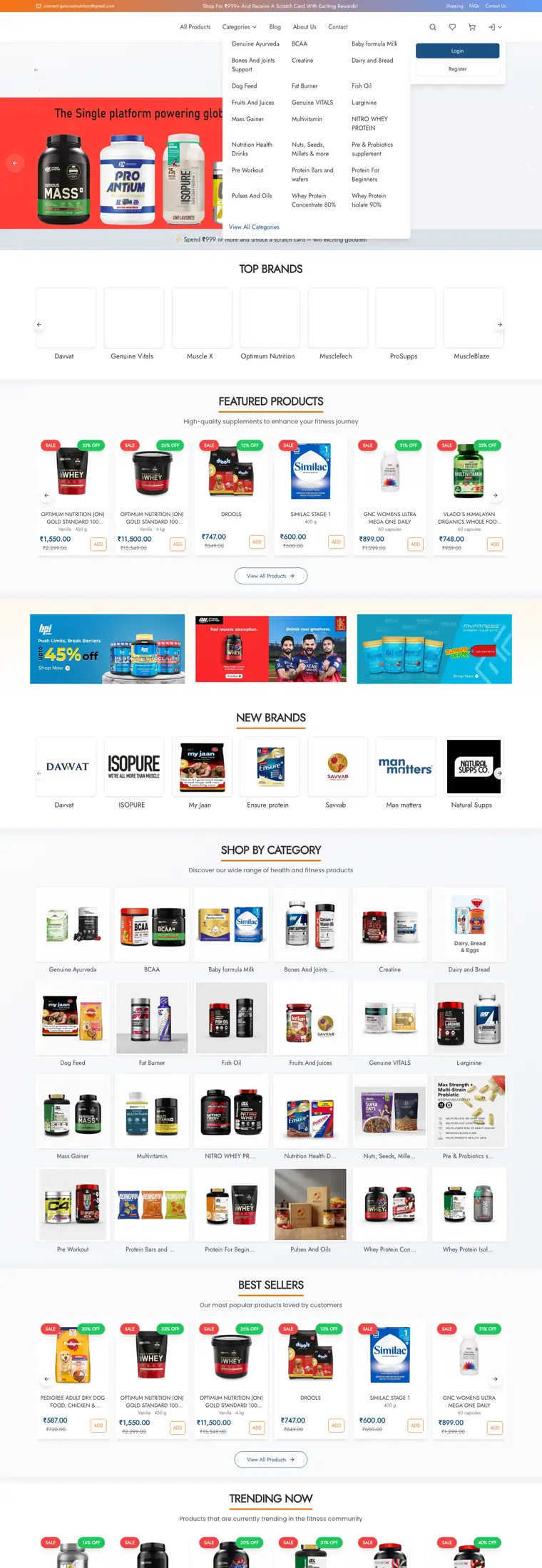
Three live stores from our portfolio. On a laptop, hover a card to scroll through the whole storefront.
Real reviews from businesses across Delhi NCR — Rated 4.9★ on Google
Send us that number and your product list. We will tell you what the store should carry, what it will cost, and which fixes pay for themselves first. The first call is free.
Delhi Office
T-16, Pocket-5, Plot No-6, Malik Builcon,
Commercial Plaza, Dwarka Sector-12,
New Delhi 110075
Phone
+91 9871228880Office Hours
Monday – Saturday, 10:00 AM – 7:00 PM